Thursday, March 6, 2014

3.1.3

Procedure: In this activity we constructed a flowchart that turned a motor on and off. I also checked the system to see if my flowchart performed as written.

I worked with Megan, Ally, and Josh in this activity. I thought it was very entertaining working with them because we are all friends and they are very nice.

Conclusion: The best way to make sure all your devises are in the correct ports of the interface and have been wired correctly is to make sure that you have followed the directions. Also, make sure you do it over again and go over the directions to make sure that you have done it correctly. If you see that you've done it wrong then you need to try again and fix what you did wrong. This incooprortaties what we have been learning all year with trail and error, after not completely the task correctly we are able to retract find our mistakes and fix them until we can fully complete the task. 

It is important to label block functions to a flowchart because it tells the system what to do. If it was not labeled nothing would happen. 


Wednesday, March 5, 2014

3.1.7

Open and Closed Loop Systems: 
In this activity we designed an open look program to control a moot driven on a track then we designed a closed loop system utilizing feedback from both analog and digital inputs to control the motor. 

Conclusion: 
1. An example is like an easy bake oven. Easy bake ovens are set times of heat to cook little meals like baby cakes or brownies or Mac n cheese. When I was little I loved easy bake ovens I found them fasicinating that I could be able to cook something on my own in a cute little pink oven. I find this cool that u could made a connection with my childhood memories!
2. A pump on an aquarium is a closed loop system because energy is always being added to them because they are always pumping water to control the life in the aquarium and keep it thriving. My brother is just completing his engineer degree and already has been working with a company for several years that works on water pumps for aquariums. His has designed the new dolphin tank at seaworld here in San Diego and several projects around the world. Now I know what type of loop systems he works with. 


Friday, February 28, 2014

3.1.5

3.1.5 Variable Function

The light was on for 5 seconds


Conclusion:
1. To make the variable block equal to 0 in the program you have to use Plus 1 command and then the next step would be to have a Minus 1 command.
2. An industrial or manufacturing engineering may need to keep track of how many products they place in a box. If the box can only hold 10 items, then the engineer will have to set the program so that it stops after it places 10 items in the box. Then they will be able to switch out the box. 


3.1.4

1. If the mini switch isn't pushed and its wire normally, the program will continue through the 0 mode.
2. The lamp will continuously be lit if I1 is normally open and the switch isn't pushed.
3. Right click and manipulate properties 5 and run program.


Input 1 (i1) is a potentiometer with an analog range of 42-5000

Conclusion:
It is important to include all the branches because of the program. Also it can make the decisions based on the actions you tell them too, which is pretty cool! A normally open switch is a light switch, and it is open when it is off and closed. Also, a closed switch is like a store alarm. It's constantly on until someone types the password in and turns the alarm off. This is just the beginning of all of the cool new things we will be able to get to work through this system. Thanks for Mr. Olson who helped us we were able to complete this and fully understand it.


Wednesday, February 5, 2014

Super Advertising 2014! "Crash The Super Bowl"

After watching the 2014 Super Bowl, the only big commercial that stuck out to me and happened to be my favorite was the Doritos Time Machine. This commercial was not only cute and funny, but it was the commercial that won the contest (Crash The Super Bowl) as the best commercial! Every year for the past 8 years, Doritos company creates a contest where anyone (in 46 different countries) can submit their own commercial and try to win a million dollars, and of course a feature in the Super Bowl. So far, I have not heard of any other company conducting this contest! After little speculation, I think they gained more money then outputting, so this contest was a smart approach in including themselves in the Super Bowl commercial favorites.

Cost:
  1. To air about 30 sec to a minute during the Super Bowl it costs about 4 million dollars
  2. The winners prize also includes 1 million dollars
Without going in depth that is already about 5 million dollars

Procedure to get 5 million dollars:
With a Dorito bag costing about 1 dollar each you need to sell 5 million bags of Doritos, in a year they usually sell 600 million, that is about 1/ 60th of there income dedicated to one Super Bowl commercial. Including that they showed 2 commercials.

Income/ Positives:
  1. Everyone submitting a commercial has to feature a bag of Doritos, many commercials featured several, sometimes hundreds, of bags.
  2. People see how easy it is to win, and next year more videos get submitted!
  3. After watching the creative funny commercial, it stuck in my head and I wrote a blog post about it, which included the craving of Doritos after typing there name so many times. 

I actually ate Doritos today, but here is the hilarious commercial I have been talking about that you can now watch :)

http://www.youtube.com/watch?v=gn-5geHkb6E

Basic Programming

 Procedure: In this activity you will construct a flow chart that will turn a motor on and off. You will also check the system to see if your flowchart performs as written. You will be introduced to four Function Blocks: start, motor, time delay, and end. 

For this assignment, I worked with Megan Ally and Josh. 

Conclusion: 
The best way to make sure that all of our devices were in the correct ports and wired correctly was by following each step percisily, and doing try and error. When a mistake was made we would try again until completing it correctly! 

It is important to labeling block functions with a flowchart to reduce the amount of error that can occur and keep track of each of your steps, to make it easy to complete this task again. It's important to keep track of what you do to also make sure that if you made a mistake you won't make the same one again! 

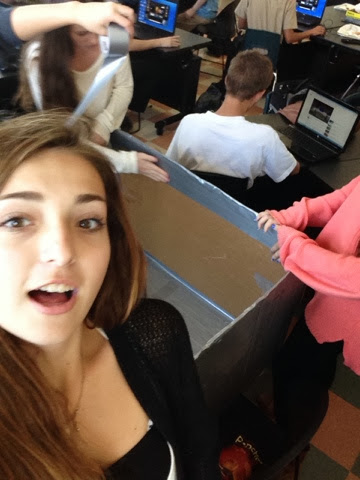
Sadly this is the only picture I could find of us completing this activity, but it's better then nothing! 

Monday, December 16, 2013

Centroids part 2 !!

Megan and I worked together on this project with help from Erik for full understanding! This is what we came up with: ( enjoy our fancy funny photos ) 


Wednesday, December 4, 2013

Manila Folder Bridge Design-Build Challenge!


Criteria:
Build a structure that can support as much weight as possible over a 18" gap.
(Note: we will use magazines for "weights" and our "gap" will be positioned between two tables)

Constraints:Part 1
    • Materials:
      • 2 "letter size" Manilla folders
      • 2' of masking tape (may not use any piece longer than 6")
    • Weighing:
      • Magazines will be used as "weights"
      • Your "score" for our competition is determined by how many magazines your structure supports!
      • Magazines will be added to your structure one at a time until "failure" is achieved.
      • You may place magazines anywhere on your structure as long as:
        • All magazines must rest between the two vertical edges of the gap your bridge is spanning (magazines must be over the "gap").
        • No magazines may touch the tables (magazines may not be piled up to "self support" themselves).
    • Construction Practices:
      • Only one end of your design may have a "pinned" connection to the table top (ie. taped). The other end must act as if it were on a "roller" connection (ie. laying on the table top).
      • Manila folders may not be layered more than 3 layers thick at any location.
      • Parallel structural members may not touch directly (they can be connected via non parallel connection members (ex. a "ladder" style design) 
Day 1:
We won this design build challenge! Megan, Alexis and I successfully held 56 magazines on our structure! Beating the record! We also happened to be the only team to complete this task on the first day, all other teams did not finish. Our design was unique and apparently very successful!! Even though everyone always doubts the girl group, and numberous times accused us for cheating, we still won :) 


Monday, November 18, 2013

4th Annual Mousetrap-Racecar Races

Criteria:
Design, build and compete with a Mousetrap Racecar (A "car" uses at least two axles).
Maintain a clean workspace.

Constraints:
One mousetrap
No more than 12" of masking tape
Fischertechnique robotics parts
No more than 24" of string
All materials used must travel with your vehicle
You must work through the stages of the event (see Achievements below)
Additional materials by Instructor approval

Achievements (by stage):
1. Completing the task on time
2. Improving distance though trials 
3. Making it the least farthest out of everyone 
4. Using good required materials 
5. Having more then 1 girl in a group
6. Most changes between trials of car


Feedback:
Next time we will improve our technique with the string and where it is placed. Also change our tactics to greaten the lengthen of the distance of our car. The different wheels chosen by different teams also seem to differ results, maybe we will change our wheel choice! My favorite part was how our distance improved after trial and error, it was a great feelings having our car go farther our second and third time trying!
We completed the task successfully and on time, next time we will win! 

Clean Up Stage: 

Megan, I and only a handful of others were the only ones at first to clean up the classroom. I swept the the whole classroom and after getting slightly annoyed made everyone stop playing minecraft and help me! Then we successfully cleaned the whole class.
  

Tuesday, October 29, 2013

Design Build Challenge 02- Marble Drop Madness!!

Todays "Design-Build"challenge uses
•14 straws
• 10 toothpicks 
• 3 paper cups
• 3 feet of masking tape
• 1 round marble 

Goals:
Realse your marble onto a freestanding contraption of your own design located at the edge of your desk. The goal is for your "structure" to direct your marble I to a cup on the floor. The winner is the teams who's cup is to cared the furthest from the edge of the desk. 

Rules: 
You may only use the materials specified above. Your marble must end up in a cup positioned on the floor in order to earn a result. 

Results: 2nd= .9
My group placed 2nd with a distance of 4 squares on the floor. We completed the marble challenge with the above materials on time, our build just wasn't long enough. 

Monday, September 30, 2013

Cardboard Canoe Challenge

I am claiming 15 achievements! 

2 years ago when I was a freshman in intro to engineering we did this challenge and weren't very successful. This year as a junior in Principals, I am trying this challenge again. This time I have a lot more knowledge on what works best and what doesn't. Hopefully, my team and I will be very successful this year.

Design 1^ (favorite design so far) 
Design 2^

Design 3^ 

Sketches^ 


20 ideas^ 

Achievements: 
•We are designing a cardboard canoe that a student must sit and without it sinking and race to the other side of the pool. 
•Personally I give our big brain to Alexis in our team
•Surface area and constraints 
 

•Select an approach: 
Since Alexis and I are the ones who have taken Engineering before and have both done the cardboard canoe challenge we combined our ideas of what we know what's and what we know doesn't. We both had remembered the canoes that won the previous years in our classes, so we combined those ideas to make ours. We used feedback and adjustments to create the design we thought would be most successful. That would be design number 1 above. 


FINAL OUTCOME- We won!!!!!! Girls team, G4, pulled a win! Even though we didnt have much time and had to change our canoe at the last minute to a complete box, we still won. The "box" team that everyone has doubted and picked fun of, beat everyone!! A great accomplishment. Yes, we used to rope, but in past years other teams have done that too, so we just happen to carry the tradition :). We were able to go back and fourth twice and stand up! Finally our canoe had had enough and fell to pieces, but it was great while it lasted! So far my group and I have no exactly figured out how to put up the videos we had taken, but we will try to upload them to youtube and I will put them up!
 
Acheivements!!!!!!!!!!!!!!!!!!!!:
1. Standing Up (balance master) 
2. Winning The Race
3. Being a Team of ALL Girls
4. Catching a Yellow Kick Board
5. Doing 2 laps there and back ( farthest )
6. Rope to pull boat across
7. Completely covered in duct tape on time
8. Boat surfboard with walls
9. Very good video/photographer (Megan)
10.Had walls above 3" tall
11. Transformer: towards the end our boat did start to sink, we turned it into something Ally could still float on!
12. We stayed in the water with our canoe for all of the competitions 
13. Not cheating or hurting other teams 
Getting the cardboard all on our own
14. Beating Mr. Olson when he swam across  
15. Being able to change our original idea last minute and still win 


Friday, September 20, 2013

Friday, September 13, 2013

First Blog Post For 2013-2014 School Year

Hi everyone! My name is Hanna and this is my blog for Principals of Enginnerring! I am involved in a number of things through my high school, but my main commiment besides school itself is Coronado High School Cheer! I am apart of the Coronado Varsity Cheerleading team, my second year on varsity as a junior. I have been cheering for my community for about 8 years now. Every year is a different experince and a different adventure. But this school year has been my favortie most memorable year yet. I love my team. Coronado High School Cheer Page


Levers Worksheet!


1st, 2nd, and 3rd class levers